| Cat # | Size | Price | Quantity | |
|---|---|---|---|---|
| 110601 | 100 ug | $120 |
| Clone | 4S.B3 |
|---|---|
| Application | Flow Cytometry |
| Reactivity | Human, Chimpanzee, Cynomolgus, Rhesus, Baboon |
| Format | Purified |
| Target Name | IFNg, IFN-g, IFN-gamma, Interferon-γ |
| Isotype | Mouse IgG1 |
| Antibody Type | Monoclonal |
| Regulatory Status | RUO |
| Formulation | Phosphate-buffered solution, pH 7.2, containing 0.09% sodium azide |
| Protein Concentration | 0.5 mg/mL |
| Storage&Handling | The antibody solution should be stored between 2°C and 8°C |
| RRID | AB_3738945 |
| Research Areas | Inflammation, Antigen Presentation, Infectious Diseases, NK cells, NKT cells, T cells, Macrophages, Dendritic cells |
| Storage & Handling | The antibody solution should be stored between 2°C and 8°C |
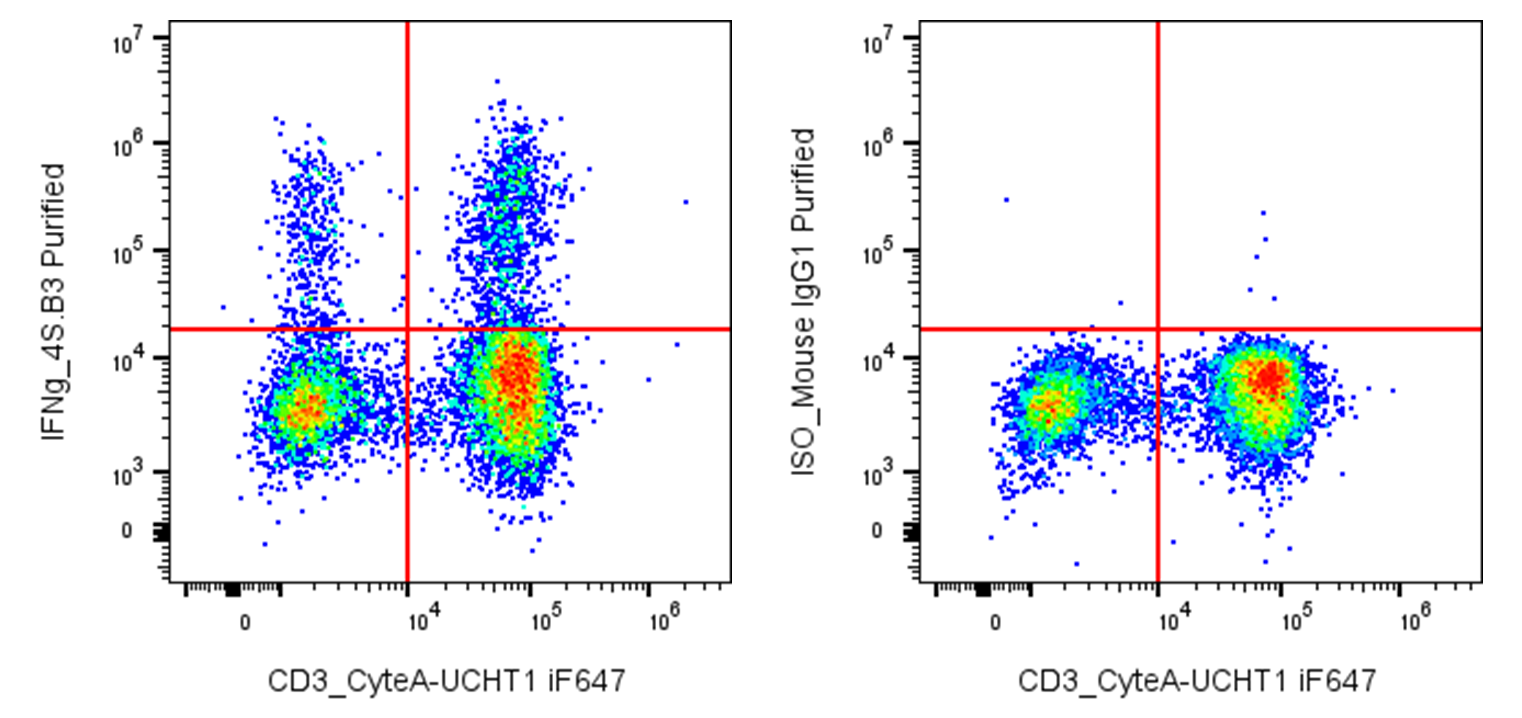
| Recommended Usage | For flow cytometric staining, it is recommended to use less than 0.2 µg of this reagent per 0.5-1.0 million cells in a 100 µL volume. Optimal reagent performance should be determined by titration for each specific application |
| See All Formats | Clone 4S.B3 |
Interferon-gamma (IFN-γ) is a cytokine with key immunoregulatory and antimicrobial functions, playing a pivotal role in both innate and adaptive immunity. It is primarily produced by activated T lymphocytes, especially CD4⁺ Th1 cells and CD8⁺ cytotoxic T cells, as well as by natural killer (NK) cells. IFN-γ serves as a crucial mediator of macrophage activation, enhances antigen presentation, and orchestrates the immune response against intracellular pathogens such as viruses, bacteria, and certain parasites. It also contributes to inflammation and immune surveillance by modulating the differentiation and function of various immune cells.
Structurally, human IFN-γ is a homodimeric glycoprotein consisting of two identical subunits of approximately 17 kDa each, yielding a biologically active molecule of about 34 kDa. Each subunit comprises an α-helical structure characteristic of the class II cytokine family. The dimer binds to its specific cell surface receptor complex, composed of two IFN-γ receptor 1 (IFNGR1) and two IFN-γ receptor 2 (IFNGR2) chains, forming a tetrameric signaling unit. This receptor engagement activates the Janus kinase (JAK)-signal transducer and activator of transcription (STAT) pathway, particularly JAK1, JAK2, and STAT1, leading to transcription of genes involved in antiviral defense, immune regulation, and cell cycle control.
The major ligands for IFN-γ are its receptors, IFNGR1 and IFNGR2, which are expressed on nearly all nucleated cells. Interaction with this receptor complex induces a broad range of immunomodulatory effects, including upregulation of major histocompatibility complex (MHC) class I and II molecules and enhancement of antigen presentation, which heightens immune recognition and cytotoxic responses.
In disease, dysregulation of IFN-γ signaling can lead to pathological consequences. Deficiency or impaired signaling causes increased susceptibility to intracellular infections such as mycobacterial and viral diseases. On the other hand, excessive IFN-γ activity contributes to chronic inflammation and autoimmunity, as seen in conditions like systemic lupus erythematosus and rheumatoid arthritis. In cancer, IFN-γ plays a dual role; it can promote anti-tumor immunity by enhancing immune cell activation but can also drive immune evasion under chronic exposure.
Therapeutically, recombinant IFN-γ is used in treating chronic granulomatous disease and severe osteopetrosis, where it enhances macrophage function. Ongoing research explores its potential in cancer immunotherapy and as an adjuvant to improve vaccine efficacy. Modulating IFN-γ signaling, either by boosting or suppressing its effects, continues to offer promising avenues for controlling immune-mediated diseases and improving therapeutic outcomes.
Mouse IgG1 Isotype Control Antibody
In Vivo Star Anti-Human CD3 Antibody, Clone SP34-2
Anti-Human TNFα (Adalimumab Biosimilar), Clone Adalimumab
Anti-Human TNF alpha (Infliximab Biosimilar), Clone Infliximab
Anti-Human IL-12 / IL-23 (Briakinumab Biosimilar), Clone Briakinumab
Anti-Human IL-12 / IL-23 (Ustekinumab Biosimilar), Clone Ustekinumab
Have a product or application question? Consult our FAQs or contact us.