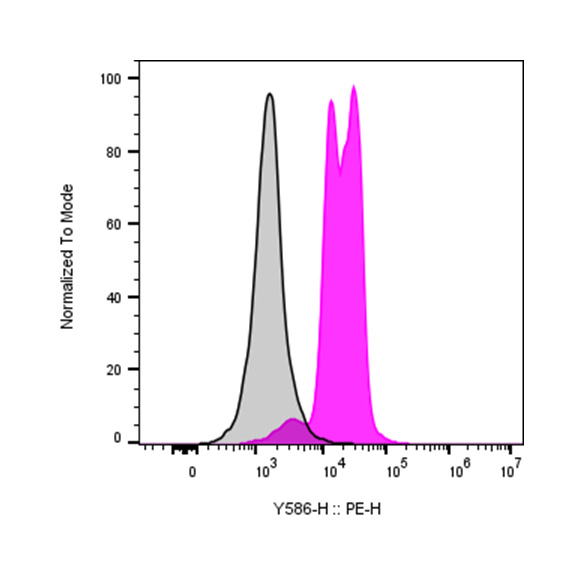
| Cat # | Size | Price | Quantity | |
|---|---|---|---|---|
| 202801 | 100 μg | $190 |
| Clone | P84 |
|---|---|
| Application | Flow Cytometry |
| Reactivity | Mouse |
| Format | Purified |
| Target Name | CD172a, P84, SHPS-1, PTPNS1 |
| Isotype | Rat IgG1 |
| Antibody Type | Monoclonal |
| Regulatory Status | RUO |
| Formulation | Phosphate-buffered solution, pH 7.2, containing 0.09% sodium azide |
| Protein Concentration | 0.5 mg/mL |
| Storage&Handling | The antibody solution should be stored between 2°C and 8°C |
| Recommended Usage | For flow cytometric staining, it is recommended to use less than 0.1 μg of this reagent per 0.5-1.0 million cells in a 100 μL volume. Optimal reagent performance should be determined by titration for each specific application. |
| RRID | AB_3739106 |
| Research Areas | Immune Checkpoints, Monocytes, Macrophages, Neutrophils, Mast cells, conventional Dendritic cells, Neurons, Hematopoietic Stem cells, IPS cells |
| See All Formats | Clone P84 |
CD172a, also known as signal regulatory protein alpha (SIRPα), is an immunoregulatory cell surface receptor that plays a key role in controlling innate immune responses, particularly phagocytosis and cell-cell interactions. CD172a is predominantly expressed on myeloid cells such as macrophages, monocytes, dendritic cells, and neutrophils, and is also found on some neuronal and endothelial cells. Its primary function is to deliver inhibitory signals that help distinguish self from non-self and prevent inappropriate immune activation.
Structurally, CD172a is a type I transmembrane glycoprotein belonging to the immunoglobulin superfamily. Its extracellular region is composed of three Ig-like domains, including a membrane-distal V-like domain that mediates ligand binding and two C1-like domains closer to the membrane. The cytoplasmic tail contains conserved immunoreceptor tyrosine-based inhibitory motifs (ITIMs), which are essential for intracellular signaling. Upon receptor engagement, these ITIMs become phosphorylated and recruit the phosphatases SHP-1 and SHP-2, leading to inhibition of activating signaling pathways.
The principal ligand for CD172a is CD47, a ubiquitously expressed cell surface protein often referred to as a “don’t eat me” signal. Interaction between CD47 on target cells and CD172a on phagocytes suppresses phagocytosis by delivering inhibitory signals to the myeloid cell. This mechanism is critical for maintaining self-tolerance and protecting healthy cells, such as red blood cells, from immune-mediated clearance. CD172a can also engage in cis interactions on the same cell surface, further modulating signaling thresholds.
CD172a plays an important role in disease, particularly in cancer and inflammatory disorders. Many tumors overexpress CD47 to exploit the CD47-CD172a pathway and evade macrophage-mediated phagocytosis. Dysregulation of CD172a signaling has also been implicated in chronic inflammation, autoimmunity, and impaired clearance of apoptotic cells. In hematologic settings, CD172a expression is used as a phenotypic marker to distinguish myeloid cell subsets.
Therapeutically, the CD47-CD172a axis has become a major focus in cancer immunotherapy. Blocking antibodies or engineered proteins that disrupt CD47-CD172a interactions are designed to remove inhibitory signals and promote phagocytosis of tumor cells by macrophages. Such approaches are being evaluated in both solid tumors and hematologic malignancies. Beyond oncology, modulation of CD172a signaling may have applications in enhancing clearance of infected or apoptotic cells, highlighting its significance as a therapeutic target and immunological checkpoint.
Rat IgG1 Isotype Control Antibody
Anti-Mouse CD172a Antibody TDS
iF488 Anti-Mouse F4/80 Antibody, Clone BM8
In Vivo Star Anti-Mouse CD370 / CD47 Bispecific Antibody, Clone 10B4 / A4
Have a product or application question? Consult our FAQs or contact us.