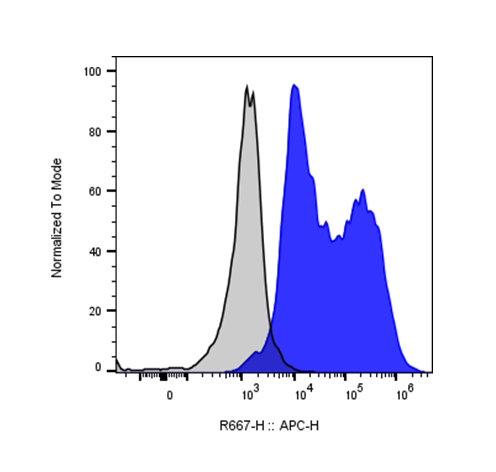
| Cat # | Size | Price | Quantity | |
|---|---|---|---|---|
| 101909 | 25 tests | $55 | ||
| 101910 | 100 tests | $140 |
| Clone | FN50 |
|---|---|
| Application | Flow Cytometry |
| Reactivity | Human |
| Format | iF647 |
| Target Name | CD69, Very Early Activation Antigent (VEA) |
| Isotype | Mouse IgG1 |
| Antibody Type | Monoclonal |
| Regulatory Status | RUO |
| Formulation | Phosphate-buffered solution, pH 7.2, containing 0.09% sodium azide and 0.2% (w/v) BSA |
| Protein Concentration | Supplied at a lot-specific concentration. |
| Storage&Handling | The antibody solution should be stored undiluted between 2°C and 8°C, and protected from prolonged exposure to light. Do not freeze. |
| Recommended Usage | For flow cytometric staining, it is recommended to use 5 µL of this reagent per 0.5-1.0 million cells in a 100 µL volume. Optimal reagent performance should be determined by titration for each specific application. iF647 has an excitation max at 656 nm and an emission max at 670 nm. |
| Excitation Laser | Red Laser (633 nm) |
| See All Formats | Clone FN50 |
CD69 is a type II transmembrane C-type lectin receptor that is best known as one of the earliest inducible markers of immune cell activation. It is rapidly upregulated on the surface of T cells, B cells, natural killer (NK) cells, dendritic cells, and other leukocytes following antigen receptor engagement, cytokine stimulation, or inflammatory signaling. While CD69 has long been used as a phenotypic activation marker, it is now recognized as an active regulator of immune cell localization and function.
Structurally, CD69 is expressed as a disulfide-linked homodimer. Each subunit contains a short N-terminal cytoplasmic tail, a single-pass transmembrane domain, and a C-terminal extracellular C-type lectin-like domain. Despite its classification within the C-type lectin family, CD69 does not require calcium for ligand binding. The cytoplasmic region includes signaling motifs that allow CD69 to associate with intracellular adaptor proteins and influence downstream signaling pathways, contributing to modulation of immune responses.
The most well-characterized ligand for CD69 is sphingosine-1-phosphate receptor 1 (S1PR1), a G protein–coupled receptor that controls lymphocyte egress from lymphoid organs into the circulation. CD69 physically associates with S1PR1, promoting its internalization and functional inhibition. This interaction restrains the migration of activated lymphocytes, leading to their retention within lymphoid tissues or sites of inflammation. Through this mechanism, CD69 plays a key role in the establishment and maintenance of tissue-resident memory T cells, which provide rapid, localized immune protection.
CD69 is involved in a broad range of disease processes. In infectious disease, CD69 expression marks recently activated effector cells and tissue-resident populations that contribute to protective immunity. In autoimmune and chronic inflammatory diseases, persistent CD69 expression can promote the accumulation of pathogenic lymphocytes in affected tissues, potentially exacerbating disease. Conversely, CD69 has also been shown to exert immunoregulatory effects by dampening excessive immune activation, highlighting its dual, context-dependent role. Elevated CD69 expression is commonly observed on tumor-infiltrating lymphocytes and may reflect ongoing immune activation or tissue residency within the tumor microenvironment.
From a therapeutic perspective, CD69 is primarily used as a biomarker to monitor immune activation, lymphocyte trafficking, and tissue residency in research and clinical settings. Although CD69 itself is not a major direct drug target, its functional interaction with S1PR1 has informed the development of therapies that modulate lymphocyte migration, such as sphingosine-1-phosphate receptor modulators used in autoimmune disease. Ongoing studies of CD69 biology continue to inform immunotherapeutic strategies aimed at enhancing protective immunity or limiting pathological inflammation.
APC Mouse IgG1 Isotype Control Antibody
APC Anti-Human CD69 Antibody TDS
APC Mouse IgG1 Isotype Control Antibody
Have a product or application question? Consult our FAQs or contact us.