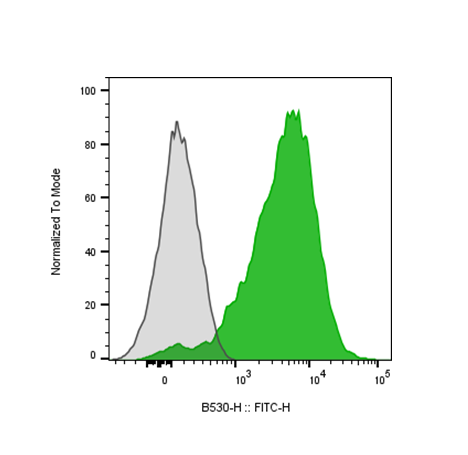
| Cat # | Size | Price | Quantity | |
|---|---|---|---|---|
| 110403 | 25 tests | $85 | ||
| 110404 | 100 tests | $230 |
| Clone | IC3 |
|---|---|
| Application | Flow Cytometry |
| Reactivity | Human |
| Format | iF488 |
| Target Name | CD63, LIMP, LAMP-3, Melanoma-associated antigen (ME491), Pltgp40, gp55 |
| Isotype | Mouse IgG2b |
| Antibody Type | Monoclonal |
| Regulatory Status | RUO |
| Formulation | Phosphate-buffered solution, pH 7.2, containing 0.09% sodium azide and 0.2% (w/v) BSA |
| Protein Concentration | Supplied at a lot-specific concentration. |
| Storage&Handling | The antibody solution should be stored undiluted between 2°C and 8°C, and protected from prolonged exposure to light. Do not freeze. |
| Recommended Usage | For flow cytometric staining, it is recommended to use 5 µL of this reagent per 0.5-1.0 million cells in a 100 µL volume. Optimal reagent performance should be determined by titration for each specific application. iF488 has an excitation max at 491 nm and an emission max at 516 nm. |
| Excitation Laser | Blue Laser (488 nm) |
| See All Formats | Clone IC3 |
CD63 is a widely expressed cell surface and intracellular protein that belongs to the tetraspanin family, a group of membrane proteins involved in organizing signaling complexes and regulating membrane dynamics. CD63 is best known as a canonical marker of late endosomes, lysosomes, and exosomes, and is commonly used in cell biology and immunology to study vesicular trafficking and extracellular vesicle biology.
Structurally, CD63 is a small (~53 kDa) type III transmembrane protein characterized by four hydrophobic transmembrane domains, two extracellular loops (a small and a large loop), and short cytoplasmic N- and C-terminal tails. The large extracellular loop contains conserved cysteine residues that form disulfide bonds, which are critical for protein stability and interactions. Like other tetraspanins, CD63 does not function primarily as a classical ligand-binding receptor but instead forms tetraspanin-enriched microdomains (TEMs) by associating laterally with other membrane proteins, including integrins, growth factor receptors, and signaling molecules.
Functionally, CD63 plays a key role in intracellular trafficking, endosomal maturation, and lysosomal targeting. It is involved in the biogenesis and cargo sorting of multivesicular bodies and exosomes, influencing the composition and release of extracellular vesicles. CD63 also participates in cell adhesion, migration, and immune signaling by regulating the surface expression and function of associated receptors. In immune cells such as mast cells, basophils, and platelets, CD63 is rapidly translocated to the cell surface upon activation, making it a well-established marker of cellular degranulation.
CD63 has been implicated in a variety of diseases. Altered CD63 expression or localization has been observed in cancer, where it can influence tumor progression, metastasis, and intercellular communication via exosomes. Depending on the tumor type, CD63 may act as a tumor suppressor or be associated with enhanced invasiveness. CD63 also plays roles in infectious diseases; several viruses, including HIV and flaviviruses, exploit CD63-associated endosomal pathways during viral entry, assembly, or egress. Additionally, defects in CD63 function have been linked to lysosomal storage disorders and impaired immune cell responses.
In therapeutic and diagnostic contexts, CD63 is primarily leveraged as a biomarker rather than a direct drug target. It is extensively used to identify and characterize exosomes in research and clinical biomarker discovery. In allergy and immunology, CD63-based flow cytometry assays are used to assess basophil and mast cell activation. Emerging therapeutic strategies aim to modulate CD63-associated pathways to influence exosome-mediated communication or to exploit CD63 expression for targeted delivery systems, highlighting its growing relevance in translational research and precision medicine.
iF488 Mouse IgG2b Isotype Control Antibody
iF488 Anti-Human CD63 Antibody TDS
iF488 Mouse IgG2b Isotype Control Antibody
Have a product or application question? Consult our FAQs or contact us.