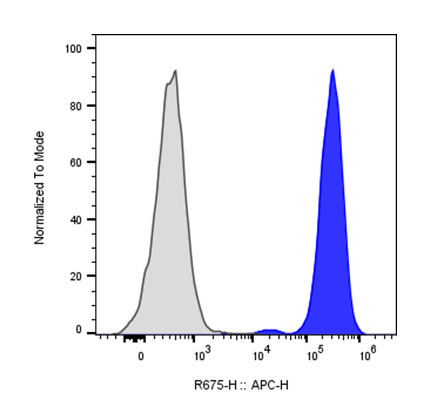
| Cat # | Size | Price | Quantity | |
|---|---|---|---|---|
| 100707 | 25 tests | $85 | ||
| 100708 | 100 tests | $195 |
| Clone | W6D3 |
|---|---|
| Application | Flow Cytometry |
| Reactivity | Human |
| Format | iF647 |
| Target Name | CD15, Lewis X, 3-FAL, 3-FL, LNFP III, Lex , SSEA-1, X-hapten |
| Isotype | Mouse IgG1 |
| Antibody Type | Monoclonal |
| Regulatory Status | RUO |
| Formulation | Phosphate-buffered solution, pH 7.2, containing 0.09% sodium azide and 0.2% (w/v) BSA |
| Protein Concentration | Supplied at a lot-specific concentration. |
| Storage and Handling | The antibody solution should be stored undiluted between 2°C and 8°C, and protected from prolonged exposure to light. Do not freeze. |
| Recommended Usage | For flow cytometric staining, it is recommended to use 5 µL of this reagent per 0.5-1.0 million cells in a 100 µL volume. Optimal reagent performance should be determined by titration for each specific application. iF647 has an excitation max at 656 nm and an emission max at 670 nm. |
| Excitation Laser | Red Laser (633 nm) |
| RRID | AB_3738584 |
| Research Areas | Cancer Marker, Neutrophils, Eosinophils, Monocytes, Macrophages, Mast cells |
| See All Formats | Clone W6D3 |
CD15, also known as Lewis X (Le^x) or stage-specific embryonic antigen-1 (SSEA-1), is a carbohydrate antigen rather than a protein receptor, distinguishing it from many other CD markers. Structurally, CD15 is a fucosylated trisaccharide (Galβ1-4(Fucα1-3)GlcNAc) that decorates glycoproteins and glycolipids on the cell surface. Its expression depends on specific glycosyltransferases rather than a dedicated gene encoding a receptor. CD15 is prominently expressed on granulocytes, particularly neutrophils, as well as on monocytes, certain epithelial cells, and subsets of tumor cells.
Functionally, CD15 plays an important role in cell–cell adhesion and leukocyte trafficking during inflammation. It serves as a key ligand for selectins, especially E-selectin and P-selectin, which are expressed on activated endothelial cells and platelets. Through these interactions, CD15 contributes to the initial “rolling” and tethering of leukocytes along the vascular endothelium, a critical early step in leukocyte extravasation into inflamed tissues. By facilitating efficient recruitment of neutrophils and other myeloid cells, CD15 supports rapid innate immune responses to infection or tissue injury.
The primary ligands for CD15 are selectins, including E-selectin (CD62E), P-selectin (CD62P), and to a lesser extent L-selectin (CD62L). These interactions are calcium-dependent and rely on the precise carbohydrate structure of CD15 and related sialylated derivatives. CD15 can be presented on multiple carrier proteins, such as mucins and other glycoproteins, which influence its binding properties and functional outcomes.
Altered CD15 expression is associated with a range of diseases. In hematopathology, CD15 is a well-established diagnostic marker for classical Hodgkin lymphoma, where it is expressed on Reed-Sternberg cells. CD15 is also used to identify and characterize myeloid leukemias and to assess neutrophil populations in inflammatory conditions. In solid tumors, aberrant CD15 expression has been linked to enhanced tumor cell adhesion, invasion, and metastasis, likely through selectin-mediated interactions with the vasculature.
In therapeutics, CD15 is primarily used as a diagnostic and stratification marker rather than a direct drug target. However, therapies aimed at disrupting selectin-CD15 interactions are being explored to reduce pathological inflammation and tumor metastasis. Additionally, CD15 expression is widely leveraged in research and clinical flow cytometry to identify granulocytes and study innate immune responses, underscoring its continued relevance in both disease biology and translational medicine.
iF647 Mouse IgG1 Isotype Control Antibody
iF647 Anti-Human CD15 (SSEA-1) Antibody TDS
iF488 Anti-Human CD16 (FcγRIII) Antibody, Clone 016AB
iF647 Anti-Human CD11b (Integrin αM) Antibody, Clone 011bAB
Have a product or application question? Consult our FAQs or contact us.