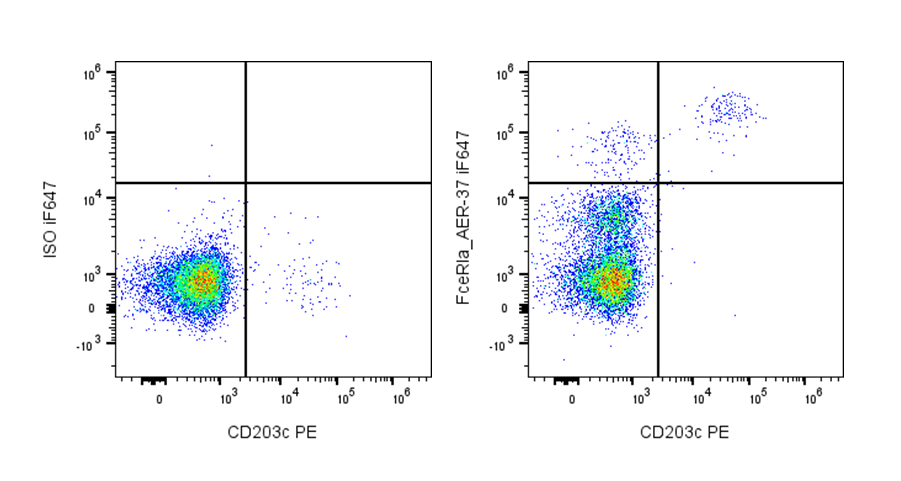
| Cat # | Size | Price | Quantity | |
|---|---|---|---|---|
| 108105 | 25 tests | $105 | ||
| 108106 | 100 tests | $280 |
| Clone | AER-37 |
|---|---|
| Application | Flow Cytometry |
| Reactivity | Human |
| Format | iF647 |
| Target Name | FcεRIα, High affinity IgE receptor, FcεRI alpha, FceRIa, FceR1a |
| Isotype | Mouse IgG2b |
| Antibody Type | Monoclonal |
| Regulatory Status | RUO |
| Formulation | Phosphate-buffered solution, pH 7.2, containing 0.09% sodium azide and 0.2% (w/v) BSA |
| Protein Concentration | Supplied at a lot-specific concentration. |
| Storage&Handling | The antibody solution should be stored undiluted between 2°C and 8°C, and protected from prolonged exposure to light. Do not freeze. |
| Recommended Usage | For flow cytometric staining, it is recommended to use 5 µL of this reagent per 0.5-1.0 million cells in a 100 µL volume. Optimal reagent performance should be determined by titration for each specific application. iF647 has an excitation max at 656 nm and an emission max at 670 nm. |
| Excitation Laser | Red Laser (633 nm) |
| See All Formats | Clone AER-37 |
FcεRIα (high-affinity immunoglobulin E receptor alpha subunit) is the primary binding component of the high-affinity receptor for IgE, known as FcεRI. This receptor plays a pivotal role in allergic responses and immune defense against parasites by mediating the activation of mast cells and basophils. Upon binding IgE, FcεRIα enables these cells to recognize antigens that cross-link surface-bound IgE, triggering potent inflammatory and allergic reactions through the release of histamine and other mediators.
Structurally, FcεRIα is a type I transmembrane glycoprotein of approximately 50-60 kDa, composed of an extracellular domain that binds the Fc portion of IgE with high specificity, a single transmembrane domain, and a short cytoplasmic tail. It is heavily glycosylated, and its extracellular region contains two immunoglobulin-like domains crucial for high-affinity IgE binding. FcεRIα pairs with the β and γ subunits, both of which contain immunoreceptor tyrosine-based activation motifs (ITAMs), to form the functional receptor complex on mast cells, basophils, and, at lower levels, on antigen-presenting cells such as dendritic cells and eosinophils. The α chain binds IgE, while the β and γ chains mediate signal transduction upon receptor aggregation. FcεRIα’s ligand is the Fc region of IgE. When an allergen bridges IgE molecules bound to FcεRI, it initiates receptor aggregation and downstream signaling cascades involving tyrosine kinases such as Lyn and Syk, leading to the release of preformed granules and synthesis of cytokines, leukotrienes, and prostaglandins. This cascade underlies immediate hypersensitivity reactions, including asthma, allergic rhinitis, urticaria, and anaphylaxis.
In disease, overactivation or dysregulation of FcεRIα-mediated pathways drives allergic and atopic disorders. Elevated surface expression of FcεRIα on immune cells is commonly observed in allergic individuals, correlating with disease severity. Conversely, soluble forms of FcεRIα can modulate IgE availability, influencing immune reactivity.
Therapeutically, FcεRIα has become an important target for allergy treatment. Omalizumab, a monoclonal antibody that binds circulating IgE, prevents its interaction with FcεRIα, thereby reducing receptor expression and mast cell activation. Novel strategies aim to block IgE-FcεRIα interactions directly or modulate receptor signaling, offering potential for treating allergic disease, asthma, and related immune hypersensitivities.
iF647 Mouse IgG2b Isotype Control Antibody
iF647 Anti-human FcεRIα Antibody TDS
iF647 Mouse IgG2b Isotype Control Antibody
Have a product or application question? Consult our FAQs or contact us.