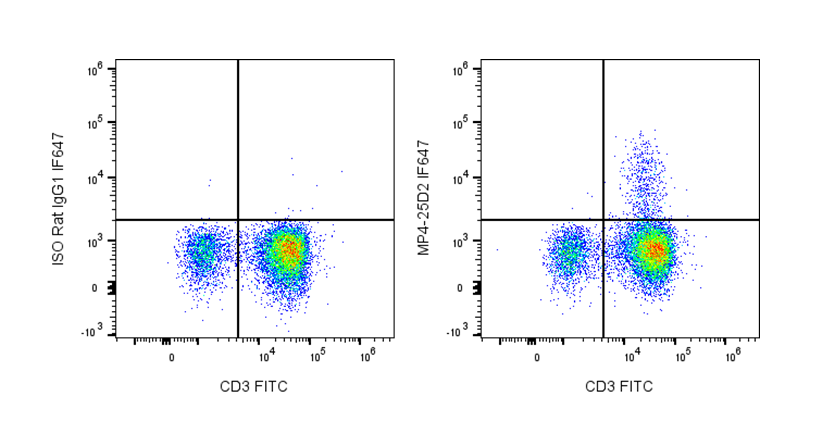
The antibody solution should be stored undiluted between 2°C and 8°C, and protected from prolonged exposure to light. Do not freeze.
Recommended Usage
For flow cytometric staining, it is recommended to use 5 uL of this reagent per 0.5-1.0 million cells in a 100 µL volume. Optimal reagent performance should be determined by titration for each specific application.
Excitation Laser
Red Laser (633 nm)
Background Information
Interleukin-4 (IL-4) is a pleiotropic, immune-modulatory cytokine produced by activated T cells, mast cells, and bone marrow stromal cells. It plays a central role in adaptive immunity, regulating T and B cell proliferation, survival, gene expression, and differentiation. IL-4 directs naive CD4⁺ T cells (Th0) into Th2 cells and promotes immunoglobulin class switching to IgG1 and IgE, while stimulating B-cell activation, T-cell proliferation, and macrophage polarization to M2 phenotype, contributing to allergic inflammation, wound repair, and tissue remodeling. IL-4 signals through two receptor complexes: the Type I receptor (IL-4Rα/γc) on hematopoietic cells, critical for Th2 differentiation, and the Type II receptor (IL-4Rα/IL-13Rα1) on non-hematopoietic cells, mediating airway hypersensitivity and mucus production. STAT6 is the key transcription factor in IL-4 signaling. Structurally, IL-4 is a compact globular protein stabilized by three disulfide bonds, featuring a four-alpha-helix bundle and a small beta-sheet, forming a stable functional fold.