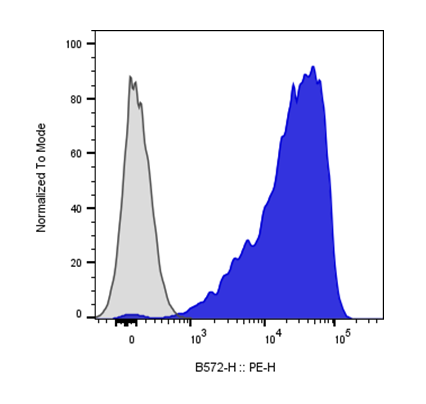
| Cat # | Size | Price | Quantity | |
|---|---|---|---|---|
| 106009 | 25 tests | $65 | ||
| 106010 | 100 tests | $175 |
| Clone | 5A6 |
|---|---|
| Application | Flow Cytometry |
| Reactivity | Human, Chimpanzee |
| Format | PE |
| Target Name | CD81, S5.7, CVID6, TSPAN28 |
| Isotype | Mouse IgG1 |
| Antibody Type | Monoclonal |
| Regulatory Status | RUO |
| Formulation | Phosphate-buffered solution, pH 7.2, containing 0.09% sodium azide and 0.2% (w/v) BSA |
| Protein Concentration | Supplied at a lot-specific concentration. |
| Storage and Handling | The antibody solution should be stored undiluted between 2°C and 8°C, and protected from prolonged exposure to light. Do not freeze. |
| Recommended Usage | For flow cytometric staining, it is recommended to use 5 µL of this reagent per 0.5-1.0 million cells in a 100 µL volume. Optimal reagent performance should be determined by titration for each specific application. PE has an excitation max at 565 nm and an emission max at 575 nm. |
| Excitation Laser | Blue Laser (488 nm) Green/Yellow laser (532/561nm) |
| RRID | AB_3738698 |
| Research Areas | B cells, T cells, Dendritic cells, Vascular Endothelial cells, Tetraspanins, Adhesion Molecules, Infectious Diseases, HCV, Plasmodium, malaria, Cancer Marker |
| See All Formats | Clone 5A6 |
CD81 is a ubiquitously expressed cell surface protein belonging to the tetraspanin family, which is involved in organizing membrane microdomains and regulating cell signaling, adhesion, and trafficking. CD81 is expressed on a wide range of cell types, including B cells, T cells, natural killer (NK) cells, dendritic cells, hepatocytes, and endothelial cells. In immunology, CD81 is best known as a component of the B cell coreceptor complex and as a canonical marker of exosomes and other extracellular vesicles.
Structurally, CD81 is a small (~26 kDa) tetraspanin protein characterized by four transmembrane helices, two extracellular loops (a small extracellular loop and a large extracellular loop), and short cytoplasmic N- and C-terminal tails. The large extracellular loop contains conserved cysteine residues that form disulfide bonds critical for maintaining structural integrity and for mediating protein–protein interactions. Rather than functioning as a classical ligand-binding receptor, CD81 organizes tetraspanin-enriched microdomains (TEMs) by associating laterally with other membrane proteins, including CD19, CD21, integrins, and signaling receptors.
Functionally, CD81 plays an important role in immune cell activation and signal transduction. On B cells, CD81 associates with CD19 and CD21 to form the B cell coreceptor complex, which lowers the threshold for B cell receptor (BCR) signaling and enhances antibody responses. CD81 also contributes to T cell activation, NK cell cytotoxicity, and cell migration by modulating the spatial organization and signaling efficiency of associated receptors. In addition, CD81 is highly enriched in exosomes, where it contributes to vesicle formation, cargo organization, and intercellular communication.
CD81 is implicated in several diseases. It is best known as a critical entry factor for hepatitis C virus (HCV), serving as a coreceptor that facilitates viral attachment and entry into hepatocytes. CD81 expression and function have also been linked to cancer progression, where altered tetraspanin networks can influence tumor cell adhesion, migration, and metastasis. In hematologic malignancies, CD81 expression patterns are used in immunophenotyping and may reflect stages of B cell differentiation or disease state.
Therapeutically, CD81 has both direct and indirect relevance. Blocking antibodies and small molecules targeting CD81 have been investigated as antiviral strategies to prevent HCV entry. In oncology and immunotherapy, CD81 is primarily leveraged as a biomarker and as a component of immune cell signaling pathways rather than a direct target. Additionally, CD81 is widely used as a surface marker for exosome isolation and characterization, supporting its growing importance in diagnostics, biomarker discovery, and the development of exosome-based therapeutic delivery systems.
PE Mouse IgG1 Isotype Control Antibody
PE Anti-Human CD81 Antibody TDS
Anti-Human CD81 Antibody, Clone 081AM2b
PE Anti-Human CD19 Antibody, Clone HIB19
FITC Anti-Human CD21 Antibody, Clone THB5
Have a product or application question? Consult our FAQs or contact us.