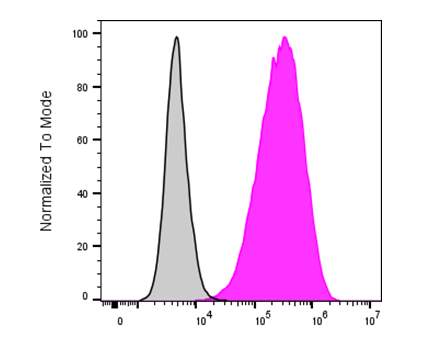
| Cat # | Size | Price | Quantity | |
|---|---|---|---|---|
| 117501 | 25 µg | $60 | ||
| 117502 | 100 µg | $120 |
| Clone | MUC1AB |
|---|---|
| Application | Flow Cytometry |
| Reactivity | Human |
| Format | Purified |
| Target Name | CD227, Mucin-1, MUC-1, HMFG antigen, MAM6, Episialin |
| Isotype | Rabbit IgG |
| Antibody Type | Monoclonal |
| Regulatory Status | RUO |
| Formulation | Phosphate-buffered solution, pH 7.2, containing 0.09% sodium azide |
| Protein Concentration | 0.5 mg/mL |
| Storage & Handling | The antibody solution should be stored between 2°C and 8°C |
| Recommended Usage | For flow cytometric staining, it is recommended to use less than 0.2 µg of this reagent per 0.5-1.0 million cells in a 100 µL volume. Optimal reagent performance should be determined by titration for each specific application |
| See All Formats | Clone MUC1AB |
Human CD227, more commonly known as mucin-1 (MUC1), is a heavily glycosylated transmembrane glycoprotein expressed on the apical surface of most glandular and epithelial cells, including those of the breast, lung, pancreas, gastrointestinal tract, and reproductive tissues. Under normal physiological conditions, MUC1 forms a protective mucous barrier that lubricates epithelial surfaces, limits pathogen adhesion, and contributes to tissue homeostasis. In addition to its barrier function, MUC1 participates in intracellular signaling pathways that regulate cell proliferation, differentiation, survival, and immune responses.
MUC1 is synthesized as a single precursor that undergoes autoproteolytic cleavage into two non-covalently associated subunits. The extracellular N-terminal subunit (MUC1-N) contains a variable number of tandem repeats (VNTRs) rich in serine, threonine, and proline residues, which serve as sites for extensive O-linked glycosylation. The C-terminal subunit (MUC1-C) consists of a short extracellular domain, a single transmembrane region, and a highly conserved cytoplasmic tail capable of interacting with signaling molecules such as β-catenin, EGFR, and NF-κB. MUC1 binds indirectly to a variety of lectins, including galectins and selectins, through its glycan structures, as well as to microbial adhesins that recognize mucin-associated carbohydrates.
MUC1 is overexpressed and aberrantly glycosylated in many epithelial cancers, including breast, pancreatic, ovarian, lung, and colorectal carcinomas. Tumor-associated MUC1 displays truncated glycans that expose novel peptide epitopes, promoting tumor growth, metastasis, immune evasion, and resistance to apoptosis. Because of its high expression and cancer-specific glycosylation patterns, MUC1 has become an important therapeutic target. Current therapeutic strategies include monoclonal antibodies, antibody-drug conjugates, cancer vaccines, bispecific T-cell engagers, CAR T-cell therapies, and small-molecule inhibitors targeting MUC1-C signaling. These approaches aim to selectively eliminate MUC1-expressing tumor cells or disrupt oncogenic signaling while minimizing toxicity to normal tissues, making MUC1 one of the most extensively studied targets in cancer immunotherapy.
Rabbit IgG, κ2 Isotype Control Antibody
Anti-Human CD227 (MUC-1) Antibody TDS
Have a product or application question? Consult our FAQs or contact us.