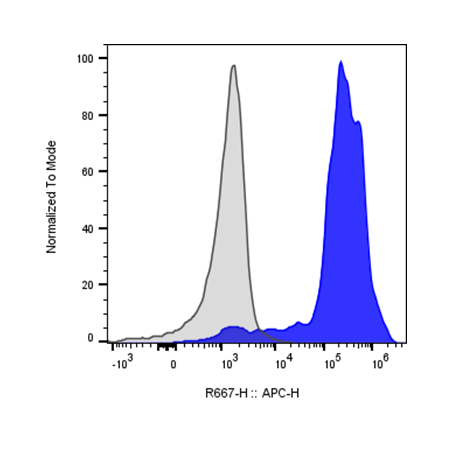
| Cat # | Size | Price | Quantity | |
|---|---|---|---|---|
| 201213 | 25 tests | $30 | ||
| 201214 | 100 tests | $80 |
| Clone | M1/70 |
|---|---|
| Application | Flow Cytometry |
| Reactivity | Human, Mouse |
| Format | APC |
| Target Name | CD11b, ITGAM, integrin αM, CR3 |
| Isotype | Rat IgG2b |
| Antibody Type | Monoclonal |
| Regulatory Status | RUO |
| Formulation | Phosphate-buffered solution, pH 7.2, containing 0.09% sodium azide and 0.2% (w/v) BSA |
| Protein Concentration | Supplied at a lot-specific concentration. |
| Storage&Handling | The antibody solution should be stored undiluted between 2°C and 8°C, and protected from prolonged exposure to light. Do not freeze. |
| Recommended Usage | For flow cytometric staining, it is recommended to use 5 µL of this reagent per 0.5-1.0 million cells in a 100 µL volume. Optimal reagent performance should be determined by titration for each specific application. APC has an excitation max at 650 nm and an emission max at 660 nm. |
| Excitation Laser | Red Laser (633 nm) |
| Research Areas | Adhesion Molecules, Macrophages, Inflammation |
| See All Formats | Clone M1/70 |
CD11b, also known as integrin αM or ITGAM, is a cell surface adhesion and signaling molecule that plays a central role in innate immune responses. It is predominantly expressed on myeloid lineage cells, including neutrophils, monocytes, macrophages, dendritic cells, and certain subsets of natural killer (NK) cells. CD11b pairs non-covalently with the β2 integrin subunit CD18 (integrin β2) to form the heterodimeric receptor Mac-1, also referred to as complement receptor 3 (CR3).
Structurally, CD11b is a type I transmembrane glycoprotein with a large extracellular domain, a single transmembrane region, and a short cytoplasmic tail. A defining feature of CD11b is the inserted (I) domain within its extracellular region, which is critical for ligand binding. Conformational changes in the CD11b/CD18 complex regulate its affinity for ligands, allowing dynamic control of cell adhesion, migration, and signaling in response to inflammatory cues. Functionally, CD11b mediates multiple immune processes, including leukocyte adhesion to the endothelium, migration into inflamed tissues, phagocytosis, and immune regulation. As complement receptor 3, CD11b binds the complement fragment iC3b deposited on opsonized pathogens or apoptotic cells, facilitating their phagocytic clearance. CD11b also participates in outside-in signaling that modulates cytokine production, respiratory burst activity, and cell survival, thereby shaping innate immune responses. CD11b interacts with a diverse range of ligands. In addition to iC3b, its ligands include intercellular adhesion molecule-1 (ICAM-1), fibrinogen, heparin, and various microbial components. Through these interactions, CD11b enables firm adhesion of leukocytes to vascular endothelium and promotes transmigration during inflammation, as well as pathogen recognition and clearance.
Altered CD11b function has been implicated in numerous diseases. Excessive or sustained CD11b-mediated activation contributes to chronic inflammatory and autoimmune conditions, such as systemic lupus erythematosus and rheumatoid arthritis. Genetic variants in ITGAM have been associated with increased susceptibility to autoimmune disease. In cancer, CD11b is commonly expressed on myeloid-derived suppressor cells (MDSCs) and tumor-associated macrophages, where it contributes to immunosuppressive tumor microenvironments and tumor progression.
Therapeutically, CD11b serves both as a biomarker and a potential target. It is widely used to identify and characterize myeloid cell populations in research and clinical settings. Emerging therapeutic strategies aim to modulate CD11b activity to reduce pathological inflammation or to reprogram suppressive myeloid cells in cancer, highlighting CD11b as an important interface between innate immunity and disease intervention.
APC Rat IgG2b Isotype Control Antibody
APC Anti-Mouse/Human CD11b (Integrin αM) Antibody TDS
Anti-Mouse CD11c (integrin αX) Antibody, Clone N418
FITC Anti-Mouse CD11c (integrin αX) Antibody, Clone N418
iF647 Anti-Mouse CD11c (integrin αX) Antibody, Clone N418-mG1
In Vivo Star Anti-Mouse CD11c (integrin αX) Antibody, Clone N418-mg1
Anti-Human CD11b (Integrin αM) Antibody, Clone 011bAB
iF647 Anti-Human CD11b (Integrin αM) Antibody, Clone 011bAB
iF488 Anti-Human CD11b (Integrin αM) Antibody, Clone 011bAM1
Have a product or application question? Consult our FAQs or contact us.