Multi-specific antibodies represent one of the most significant advances in cancer immunotherapy over the past decade, moving beyond the single-target logic of conventional monoclonal antibodies to simultaneously engage tumor antigens and immune effector cells. By physically bridging a cytotoxic lymphocyte to a malignant cell, these engineered proteins redirect the immune system's killing machinery with a specificity and potency that neither component achieves alone. What began with bispecific T cell engagers (BiTEs) targeting CD3 has expanded into a diverse toolbox spanning NK cell engagers, trispecific constructs, and next-generation formats designed to overcome resistance, toxicity, and manufacturing hurdles.
The core principle of a bispecific T cell engager (BiTE) is straightforward: one arm binds CD3ε on the T cell receptor complex, while the other arm binds a tumor-associated antigen (TAA) such as CD19, CD20, BCMA, or GPRC5D. This forces formation of an immunological synapse independent of T cell receptor (TCR) specificity or MHC presentation, triggering perforin/granzyme- mediated lysis of the tumor cell alongside T cell activation, proliferation, and cytokine release. Because activation is antigen- driven rather than antigen-specific to a clonal TCR, BiTEs can recruit the entire polyclonal T cell repertoire, including cells that would otherwise be anergic to the tumor.
NK cell engagers (NKCEs) apply the same bridging logic but redirect natural killer cells, most commonly via activating receptors such as CD16 (FcγRIIIa), NKG2D, or NKp46, rather than CD3. NK engagers offer a potentially safer profile since NK cell activation does not typically trigger the massive cytokine cascades associated with T cell engagement, and NK cells can kill in an MHC-independent manner, making them attractive for tumors that downregulate MHC class I to escape T cell surveillance.
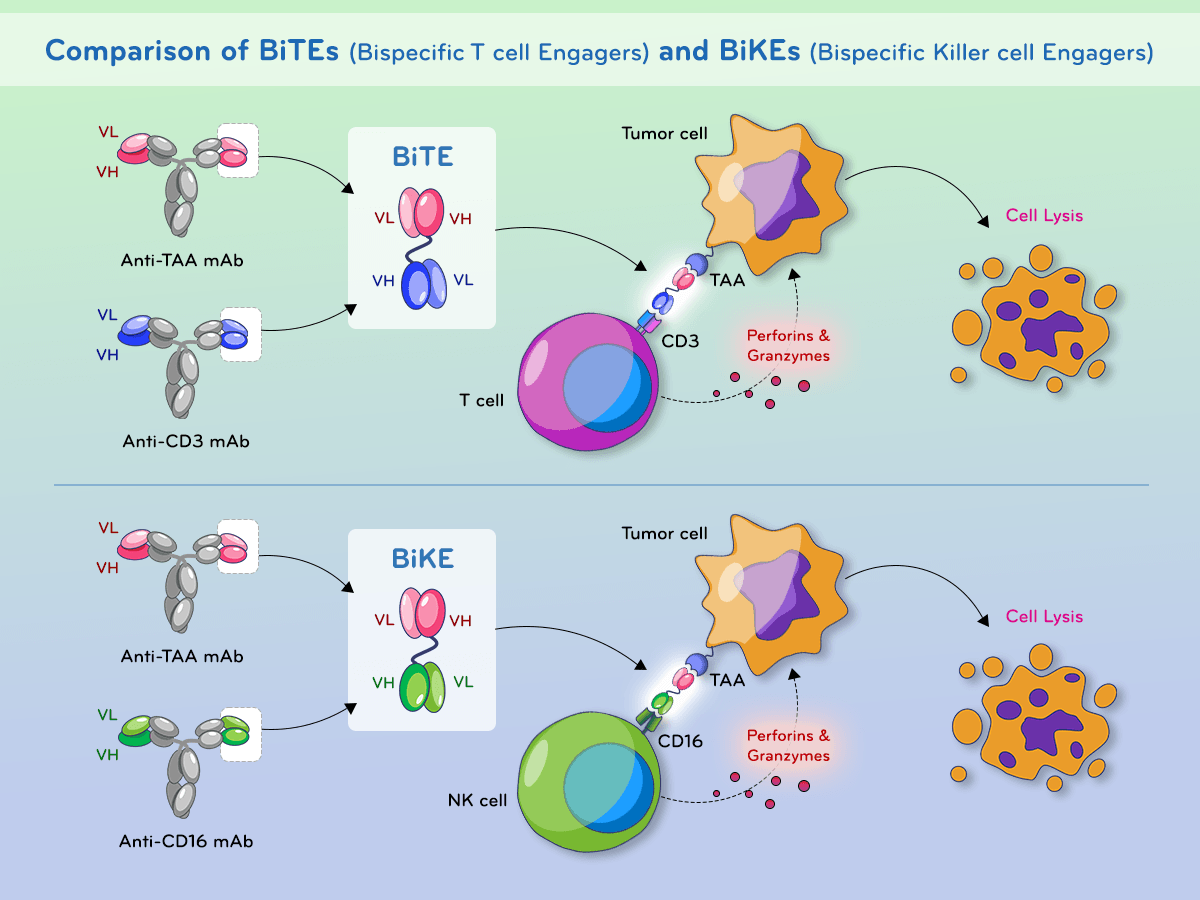
Fig. 1. A comparison of BiTEs and BiKEs, two bispecific antibody formats built by fusing the variable domains of an anti-Tumor Associated Antigen antibody with those of an anti-CD3 (for BiTEs) or anti-CD16 (for BiKEs) antibody, linking a tumor cell to an immune effector cell. In both cases, this bridging triggers release of perforins and granzymes from the effector cell, T cells for BiTEs, NK cells for BiKEs, resulting in targeted lysis of the tumor cell.
Several bispecific T cell engagers have reached clinical approval and reshaped treatment paradigms in hematologic malignancy:
In solid tumors, progress has been slower due to antigen heterogeneity, physical barriers, and on-target/off-tumor toxicity risk, but engagers targeting EpCAM, HER2, MUC16, and DLL3 (for small cell lung cancer, e.g., tarlatamab) are advancing through clinical development, with tarlatamab recently gaining approval.
NK cell engager programs remain earlier stage but are progressing rapidly, with CD16-based and NKG2D-based constructs (some incorporating IL-15 fusion domains to support NK persistence) entering clinical trials for both hematologic and solid indications.
Trispecific antibodies add a third binding arm to improve efficacy, safety, or persistence. Common architectures include:
PD-1/VEGF-A and PD-L1/VEGFR2 bispecifics represent a distinct and rapidly growing category that pairs immune checkpoint blockade with anti-angiogenic activity in a single molecule, aiming to normalize tumor vasculature while relieving T cell exhaustion — a rational combination given the well-documented crosstalk between VEGF signaling and immunosuppressive tumor microenvironments. Early clinical data (e.g., ivonescimab) suggest potential synergy over either mechanism alone.
Emerging checkpoint-engager hybrids, such as constructs bridging inhibitory receptors like CD200R1/PD-L1 or novel targets analogous to CD47/SIRPα-adjacent pathways, are being explored to simultaneously disable "don't find me" and "don't eat me" signals.
Other frontiers include: logic-gated engagers (AND/NOT gates using masked or prodrug-like formats to restrict activity to the tumor microenvironment), half-life-extended low-affinity CD3 binders to reduce cytokine release syndrome (CRS), NK engager fusions with IL-2/IL-15 variants to sustain persistence without systemic toxicity, and engagers designed for subcutaneous dosing to improve outpatient administration.
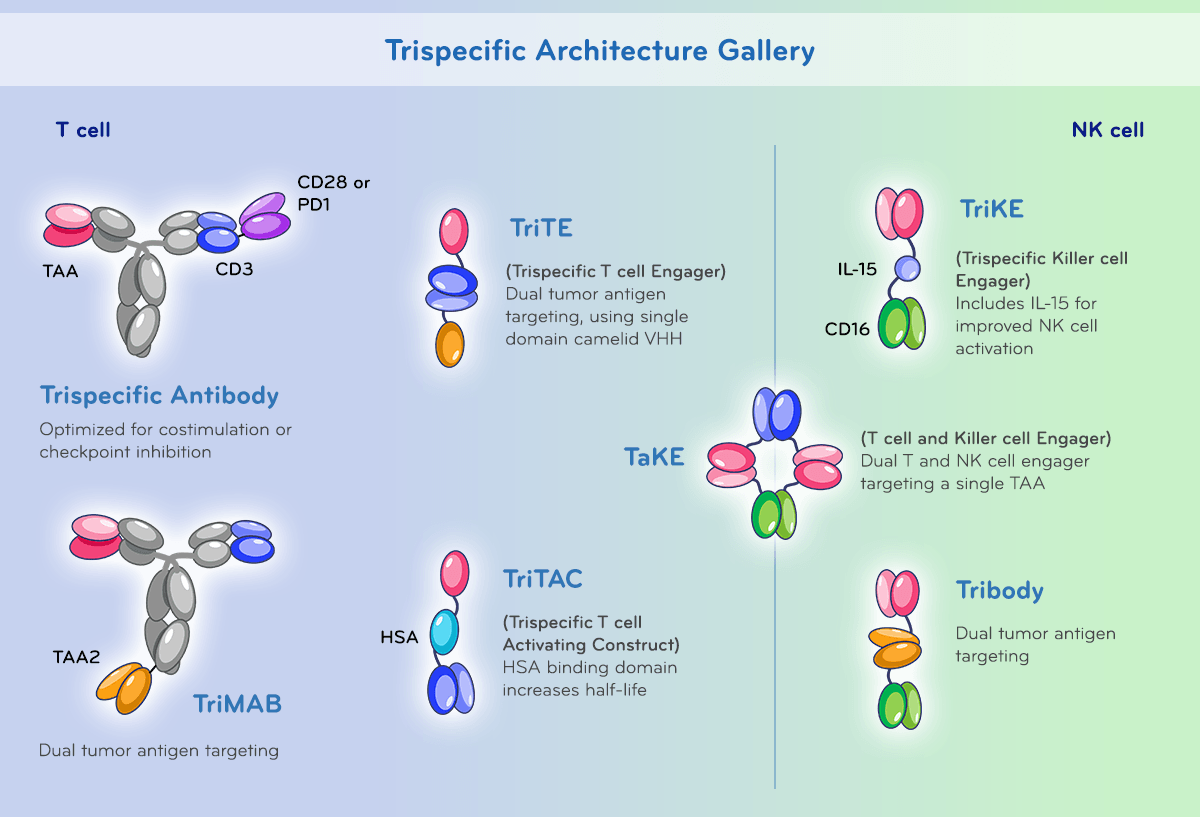
Fig. 2. This gallery illustrates a handful of examples of how trispecific antibody engineering diversifies beyond simple bispecifics by adding a third binding arm, enabling options for targeting a second tumor antigen (avidity/specificity), a costimulatory signal (potency), a half-life extender (pharmacokinetics), or a second effector cell type (broader immune engagement). The concepts reflect the modular design logic driving next-generation immunotherapeutics.
Research into bispecific and trispecific engagers depends on high-quality, well-characterized reagents at every stage, from target validation through functional cytotoxicity assays. InnoCyto's primary antibody and recombinant protein portfolio, including antibodies and proteins against CD3, CD16, CD19, CD20, BCMA, PD-1, PD-L1, VEGF family targets, EpCAM, and HER2, supports flow cytometry-based immune synapse characterization, effector cell phenotyping, and target antigen expression profiling essential to engager development. Complementary biosimilar and immune checkpoint product lines enable head-to-head functional benchmarking and combination studies, while InnoCyto's Flow Cytometry-optimized antibody clones allow researchers to directly monitor T cell and NK cell activation markers and cytokine release during in vitro engager potency assays, providing the validated tools needed to accelerate discovery and translational research in this rapidly evolving therapeutic class.
Contact us for expert support.