Cancer immunotherapy has moved decisively beyond one-size-fits-all treatment toward a portfolio of mechanistically distinct strategies, each exploiting a different node in the tumor–immune interface. BiTEs/TriTEs and CAR-T therapies both redirect T (or NK) cells to kill tumor cells in an MHC-independent, antigen-driven manner, but they diverge sharply in execution: BiTEs/TriTEs are off-the-shelf biologics that recruit the patient's own circulating effector cells in situ, while CAR-T requires weeks-long, patient-specific (or allogeneic) cell engineering to produce a "living drug" capable of durable persistence. ADCs take a fundamentally different route, using an antibody purely as a delivery vehicle to shuttle cytotoxic payloads directly into antigen- positive cells (no immune effector engagement required), while checkpoint inhibitors don't introduce new killing activity at all, instead releasing the brakes on a patient's pre-existing, TCR-restricted anti-tumor T cells. Together these four modalities illustrate the field's core insight: tumors can be attacked by redirecting immune cells, arming antibodies as chemotherapy-delivery drones, or unleashing immunity that's already present but suppressed.
The clinical significance lies in how these mechanisms complement each other's blind spots. Engager and CAR-T platforms have transformed outcomes in hematologic malignancies (CD19/BCMA-directed approaches) but still struggle against the hostile, poorly infiltrated tumor microenvironment of solid tumors, a limitation checkpoint inhibitors and ADCs partially sidestep, since ADCs act locally once internalized and checkpoint inhibitors work across many established solid-tumor indications wherever a reactivatable T-cell pool exists. Each approach also carries a distinct toxicity and durability profile: CRS/ICANS for engagers and CAR-T, payload-related toxicities for ADCs, and immune-related adverse events for checkpoint blockade, which is why the field is increasingly moving toward rational combinations (e.g., CAR-T or BiTEs paired with checkpoint inhibitors, or ADCs layered with immune-engaging agents) rather than relying on any single platform in isolation.
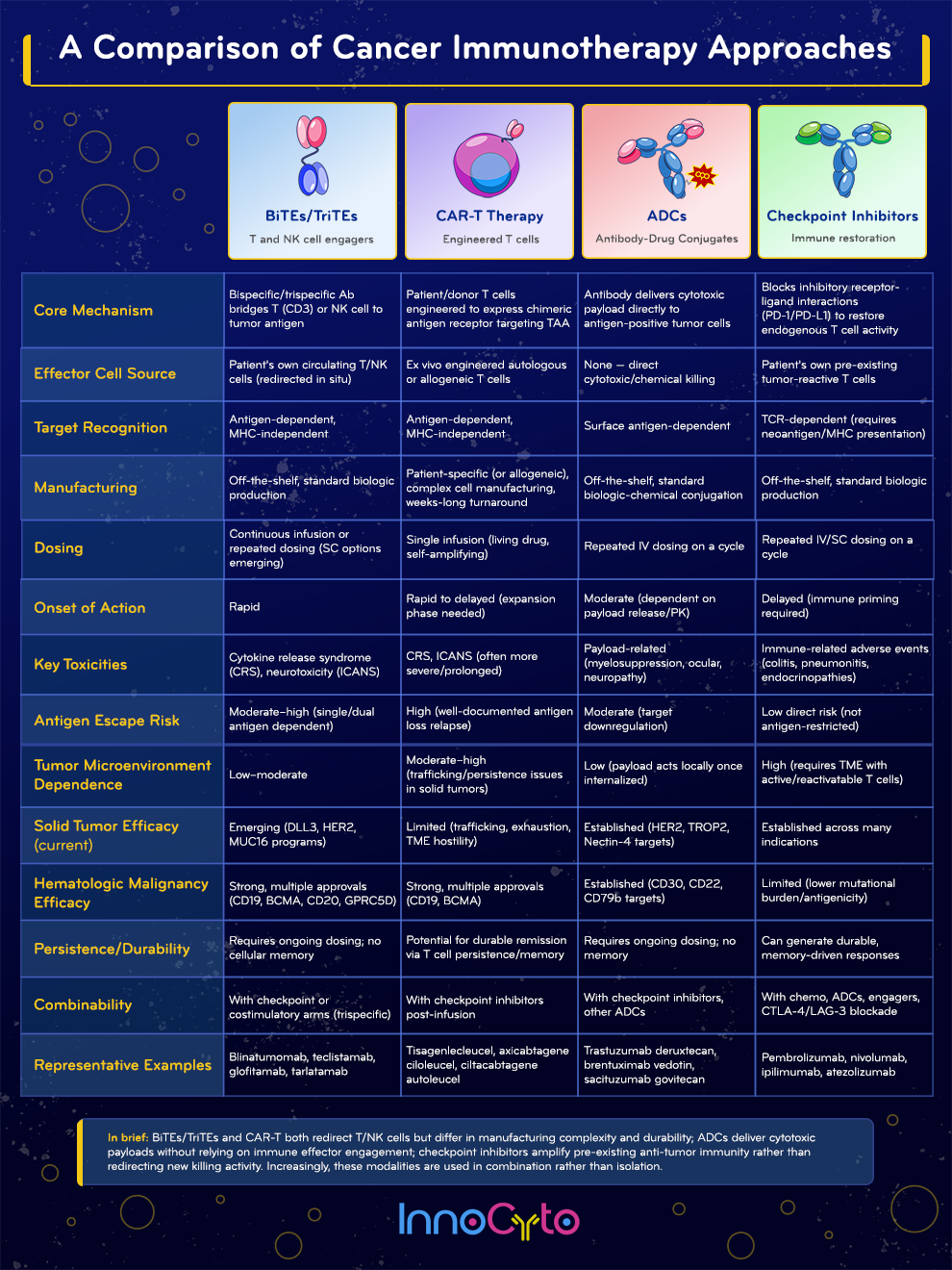
This table distills the complexity of modern cancer immunotherapy into a single, at-a-glance reference. By aligning BiTEs/TriTEs, CAR-T, ADCs, and Checkpoint Inhibitors across 14 key dimensions (mechanism, effector cell source, manufacturing burden, onset of action, toxicity profile, antigen escape risk, tumor microenvironment dependence, efficacy by tumor type, durability, and combinability) it allows for rapid, side-by-side evaluation of how each approach works and where it excels or falls short. Rather than parsing separate technical literature for each drug class, readers can instantly triangulate critical trade-offs, such as CAR-T's durable remission potential against its lengthy manufacturing timeline, or an ADC's established solid-tumor efficacy against its lack of immunologic memory. The result is a fast, visually scannable comparator built for anyone, clinicians, researchers, or business stakeholders, who needs to grasp the differentiation between these four modalities at a glance.
Contact an expert for more detailed support.