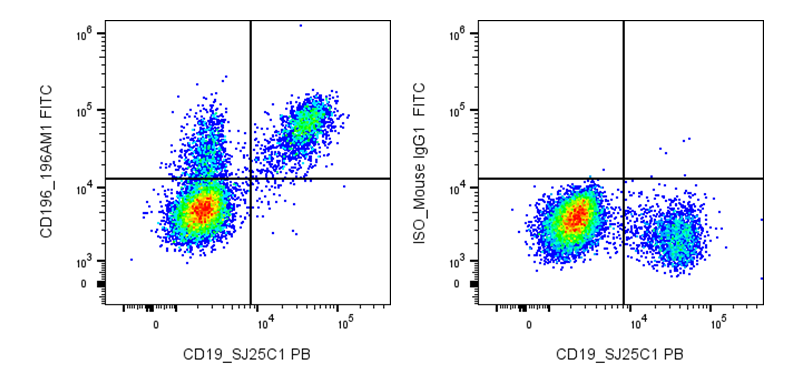
| Cat # | Size | Price | Quantity | |
|---|---|---|---|---|
| 119703 | 25 tests | $110 | ||
| 119704 | 100 tests | $250 |
| Clone | 196AM1 |
|---|---|
| Application | Flow Cytometry |
| Reactivity | Human |
| Format | FITC |
| Target Name | CD196, CCR6, CKR6, GPR29, CMKBR6 |
| Isotype | Mouse IgG1 |
| Antibody Type | Monoclonal |
| Regulatory Status | RUO |
| Formulation | Phosphate-buffered solution, pH 7.2, containing 0.09% sodium azide and 0.2% (w/v) BSA |
| Protein Concentration | Supplied at a lot-specific concentration. |
| Storage&Handling | The antibody solution should be stored undiluted between 2°C and 8°C, and protected from prolonged exposure to light. Do not freeze. |
| Recommended Usage | For flow cytometric staining, it is recommended to use 5 µL of this reagent per 0.5-1.0 million cells in a 100 µL volume. Optimal reagent performance should be determined by titration for each specific application. FITC has an excitation max at 493 nm and an emission max at 525 nm. |
| Excitation Laser | Blue Laser (488 nm) |
| See All Formats | Clone 196AM1 |
Human CD196, also known as CCR6 (C-C chemokine receptor 6), is a member of the G protein-coupled receptor (GPCR) family that regulates immune cell migration and tissue homing. CD196 is expressed on immature dendritic cells, memory T cells, B cells, regulatory T cells (Tregs), Th17 cells, innate lymphoid cells, and subsets of natural killer (NK) cells. It plays a critical role in directing leukocytes to epithelial tissues and sites of inflammation, particularly the skin, lungs, and gastrointestinal tract, where it contributes to both immune surveillance and inflammatory responses.
CCR6 is a seven-transmembrane domain receptor composed of approximately 374 amino acids, with an extracellular N-terminus involved in ligand recognition and an intracellular C-terminal tail that mediates signaling. Its primary and highly specific ligand is CCL20 (also known as macrophage inflammatory protein-3 alpha, MIP-3α, or liver activation-regulated chemokine, LARC). Binding of CCL20 to CCR6 activates heterotrimeric Gi proteins, triggering intracellular signaling pathways including PI3K, MAPK, and calcium mobilization, which promote chemotaxis, cell survival, and immune cell activation.
The CCR6-CCL20 signaling axis plays an important role in numerous inflammatory and autoimmune diseases. Elevated CCR6 expression is associated with psoriasis, rheumatoid arthritis, inflammatory bowel disease, multiple sclerosis, asthma, and systemic lupus erythematosus, largely through the recruitment of Th17 cells and other pro-inflammatory leukocytes. In cancer, CCR6 expression has been linked to tumor progression, metastasis, and immune cell infiltration in malignancies such as colorectal, breast, pancreatic, and hepatocellular carcinoma, although its biological effects vary depending on the tumor microenvironment.
Because of its central role in immune cell trafficking, CCR6 has emerged as an attractive therapeutic target. Small-molecule antagonists, monoclonal antibodies, and inhibitors of the CCR6-CCL20 axis are under investigation for the treatment of autoimmune diseases, chronic inflammatory disorders, and cancer. Modulating CCR6 signaling may reduce pathogenic immune cell recruitment while preserving normal immune surveillance, making CD196 a promising target for future immunotherapies and precision medicine approaches.
FITC Mouse IgG1 Isotype Control Antibody
FITC Anti-Human CD196 (CCR6) Antibody TDS
Have a product or application question? Consult our FAQs or contact us.