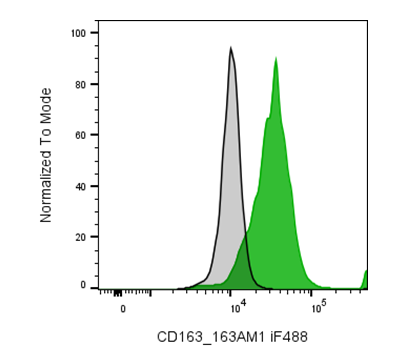
| Cat # | Size | Price | Quantity | |
|---|---|---|---|---|
| 117707 | 25 tests | $95 | ||
| 117708 | 100 tests | $280 |
| Clone | 163AM1 |
|---|---|
| Application | Flow Cytometry |
| Reactivity | Human |
| Format | iF488 |
| Target Name | CD163, M130 |
| Isotype | Mouse IgG1 |
| Antibody Type | Monoclonal |
| Regulatory Status | RUO |
| Formulation | Phosphate-buffered solution, pH 7.2, containing 0.09% sodium azide and 0.2% (w/v) BSA |
| Protein Concentration | Supplied at a lot-specific concentration. |
| Storage&Handling | The antibody solution should be stored undiluted between 2°C and 8°C, and protected from prolonged exposure to light. Do not freeze. |
| Recommended Usage | For flow cytometric staining, it is recommended to use 5 µL of this reagent per 0.5-1.0 million cells in a 100 µL volume. Optimal reagent performance should be determined by titration for each specific application. iF488 has an excitation max at 491 nm and an emission max at 516 nm. |
| Excitation Laser | Blue Laser (488 nm) |
| See All Formats | Clone 163AM1 |
Human CD163 is a member of the scavenger receptor cysteine-rich (SRCR) superfamily that is expressed predominantly on monocytes, tissue macrophages, and specialized anti-inflammatory (M2-like) macrophages. Its primary physiological function is to mediate the clearance of hemoglobin released during red blood cell breakdown by binding hemoglobin-haptoglobin (Hb-Hp) complexes. Internalization of these complexes promotes iron recycling, limits oxidative tissue damage, and contributes to the resolution of inflammation. CD163 expression is upregulated by anti-inflammatory mediators such as interleukin-10 and glucocorticoids and is reduced by pro-inflammatory cytokines, reflecting its important role in maintaining immune homeostasis.
Structurally, CD163 is a type I transmembrane glycoprotein composed of a large extracellular region containing nine scavenger receptor cysteine-rich (SRCR) domains, a single transmembrane helix, and a short cytoplasmic tail involved in receptor internalization. Proteolytic cleavage of the extracellular domain by metalloproteases, particularly ADAM17, generates soluble CD163 (sCD163), which circulates in plasma and serves as a biomarker of macrophage activation. The best-characterized ligand is the hemoglobin-haptoglobin complex, although CD163 can also interact with selected bacterial components and endogenous inflammatory mediators.
CD163 has been implicated in numerous diseases characterized by inflammation or macrophage activation, including sepsis, atherosclerosis, liver disease, rheumatoid arthritis, obesity, and several cancers. Elevated circulating sCD163 levels often correlate with disease severity and prognosis. Tumor-associated macrophages expressing high levels of CD163 are frequently associated with an immunosuppressive tumor microenvironment and poor clinical outcomes.
Therapeutically, CD163 is an attractive target for macrophage-specific drug delivery because of its restricted expression and efficient endocytic activity. Antibody-drug conjugates, nanoparticles, and antibody-cytokine fusion proteins directed against CD163 are being developed to selectively modulate macrophage function while minimizing systemic toxicity. In addition, sCD163 is being investigated as a diagnostic and prognostic biomarker for inflammatory, infectious, metabolic, and malignant diseases.
iF488 Mouse IgG1 Isotype Control Antibody
iF488 Anti-Human CD163 Antibody TDS
Have a product or application question? Consult our FAQs or contact us.