| Cat # | Size | Price | Quantity | |
|---|---|---|---|---|
| 200907 | 25 μg | $85 | ||
| 200908 | 100 μg | $195 |
| Clone | RA3-6B2 |
|---|---|
| Application | Flow Cytometry |
| Reactivity | Human, Mouse, Chimpanzee |
| Format | iF647 |
| Target Name | CD45R, B220 |
| Isotype | Rat IgG2a |
| Antibody Type | Monoclonal |
| Regulatory Status | RUO |
| Formulation | Phosphate-buffered solution, pH 7.2, containing 0.09% sodium azide and 0.2% (w/v) BSA |
| Protein Concentration | Supplied at a lot-specific concentration. |
| Storage and Handling | The antibody solution should be stored undiluted between 2°C and 8°C, and protected from prolonged exposure to light. Do not freeze. |
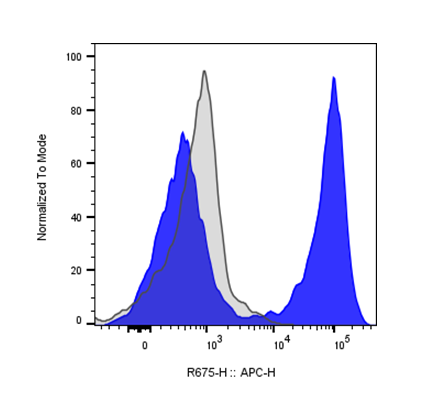
| Recommended Usage | For flow cytometric staining, it is recommended to use less than 0.2 μg of this reagent per 0.5-1.0 million cells in a 100 μL volume. Optimal reagent performance should be determined by titration for each specific application. iF647 has an excitation max at 656 nm and an emission max at 670 nm. |
| Excitation Laser | Red Laser (633 nm) |
| RRID | AB_3739013 |
| Research Areas | B cells |
| See All Formats | Clone RA3-6B2 |
CD45R/B220 is a widely used immunological marker that represents a specific isoform of the protein tyrosine phosphatase CD45 (PTPRC). B220 is most commonly associated with B lymphocytes, particularly in mice, where it is expressed throughout much of B cell development and maturation. While B220 is often referred to as a “B cell marker,” it is also expressed on subsets of activated T cells, dendritic cells, and certain leukemic populations, reflecting its role in immune regulation rather than lineage restriction.
Structurally, CD45R/B220 is a type I transmembrane glycoprotein generated through alternative splicing of the CD45 extracellular domain. The B220 isoform includes exon A and produces a high–molecular weight extracellular region compared with other CD45 isoforms such as CD45RO. Like all CD45 family members, B220 contains a single transmembrane domain and a cytoplasmic tail with two protein tyrosine phosphatase domains, of which the membrane-proximal domain is catalytically active. The extracellular domain is heavily glycosylated, contributing to its size and antibody recognition.
CD45R/B220 does not bind a classical extracellular ligand. Instead, its primary function is enzymatic, regulating signaling thresholds in immune cells. In B cells, B220 modulates B cell receptor (BCR) signaling by dephosphorylating Src family kinases such as Lyn, thereby fine-tuning activation, survival, and tolerance. Through this activity, CD45R/B220 ensures that B cells respond appropriately to antigen stimulation while limiting aberrant activation.
CD45R/B220 plays important roles in disease. Altered expression of B220 is observed in autoimmune models, where dysregulated B cell signaling contributes to loss of tolerance and autoantibody production. In murine models of lupus-like disease, abnormal B220 expression is associated with expanded populations of atypical B cells. B220 is also a key diagnostic marker in hematologic malignancies, particularly B cell leukemias and lymphomas, where it aids in immunophenotypic classification. Additionally, aberrant B220 expression on T cells can be a feature of lymphoproliferative disorders.
Therapeutically, CD45R/B220 is primarily used as a biomarker and experimental tool rather than a direct drug target. Antibodies against B220 are routinely employed to identify, isolate, or deplete B cells in research and preclinical studies. In translational contexts, targeting CD45 isoforms, including B220-expressing cells, has been explored in conditioning regimens for bone marrow transplantation and in antibody-based approaches for hematologic disease, highlighting its enduring importance in immunology.
iF647 Rat IgG2a Isotype Control Antibody
iF647 Anti-Mouse/human CD45R/B220 Antibody TDS
iF647 Anti-Mouse CD19 Antibody, Clone 1D3
In Vivo Star Anti-Mouse CD20 Antibody, Clone 18B12
Have a product or application question? Consult our FAQs or contact us.