Immune checkpoints are regulatory pathways within the immune system that maintain self-tolerance and modulate the duration and amplitude of physiological immune responses. Under normal conditions, these molecular "brakes" prevent excessive or misdirected immune activation, protecting healthy tissue from autoimmune damage while allowing pathogen clearance. Both co-inhibitory and co-stimulatory receptor-ligand pairs are expressed on T cells, antigen-presenting cells (APCs), and, importantly, tumor cells, which have evolved to hijack these pathways for immune evasion.
The clinical relevance of immune checkpoints became unmistakable with the development of checkpoint inhibitor therapies, which block inhibitory signals to restore antitumor T-cell activity. This breakthrough, recognized by the 2018 Nobel Prize in Physiology or Medicine awarded to James P. Allison and Tasuku Honjo, transformed oncology by demonstrating that manipulating endogenous immune regulation, rather than directly targeting tumor cells, could produce durable clinical responses across multiple cancer types. Since then, checkpoint biology has expanded well beyond CTLA-4 and PD-1/PD-L1, with an expanding roster of novel targets now in clinical development. For researchers working in flow cytometry, hybridoma- derived antibody development, and biosimilar characterization, a solid grasp of checkpoint receptor-ligand biology is foundational to designing accurate detection panels, functional assays, and next-generation therapeutic candidates.
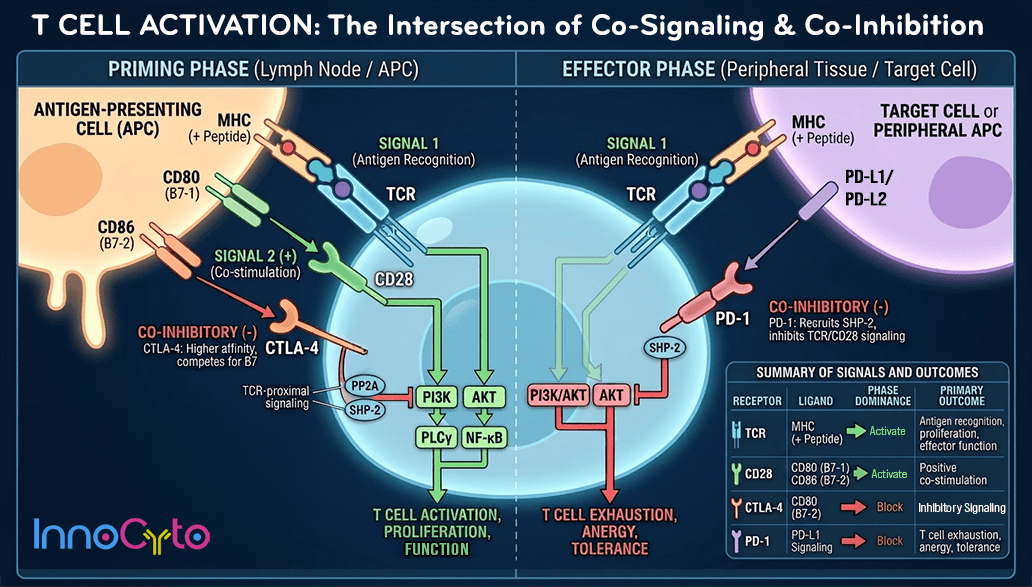
CTLA-4 (CD152) is expressed on activated T cells and constitutively on regulatory T cells (Tregs). It competes with the co- stimulatory receptor CD28 for binding to CD80/CD86 (B7-1/B7-2) on APCs, with higher affinity and avidity than CD28. By outcompeting CD28 engagement, CTLA-4 dampens the initial priming phase of T-cell activation in lymph nodes. Ipilimumab, the first FDA-approved checkpoint inhibitor (2011), targets this axis.
PD-1 (CD279) is upregulated on chronically stimulated or "exhausted" T cells within peripheral tissues and the tumor microenvironment (TME). Its ligands, PD-L1 (CD274) and PD-L2 (CD273), are expressed on tumor cells, myeloid cells, and stromal cells. PD-1/PD-L1 engagement recruits SHP-2 phosphatase, dephosphorylating TCR/CD28 signaling components and attenuating effector function locally at the site of antigen encounter—distinguishing it functionally from the more centrally- acting CTLA-4.
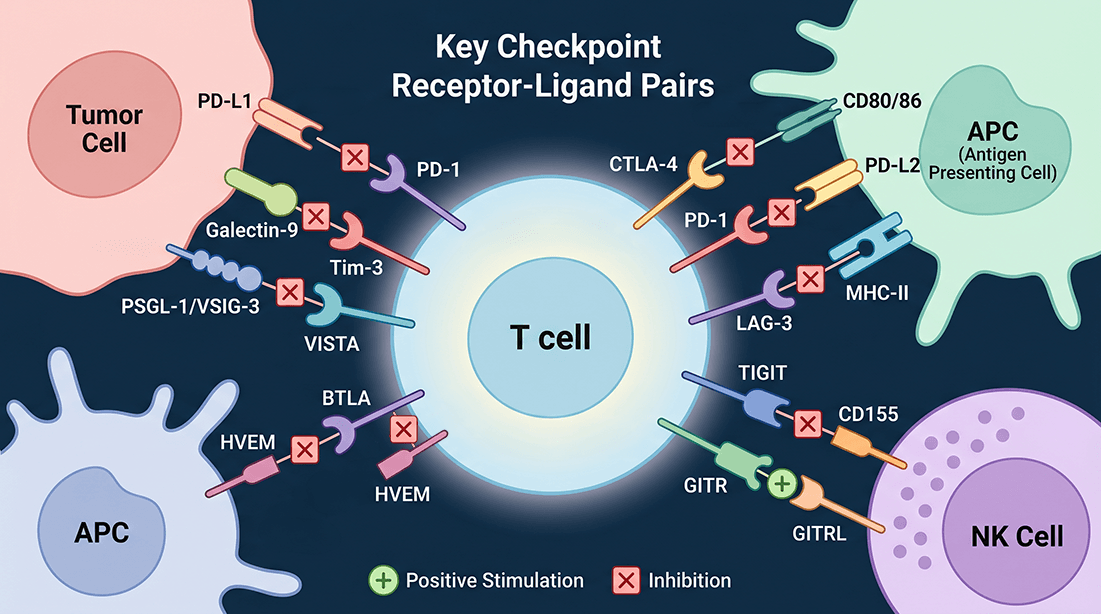
LAG-3 (CD223) binds MHC class II and the alternative ligand FGL1, contributing to T-cell exhaustion and Treg suppressive function. It is frequently co-expressed with PD-1 on exhausted T cells, providing rationale for combination blockade.
TIM-3 (HAVCR2) engages multiple ligands, including galectin-9, phosphatidylserine, HMGB1, and CEACAM1, and marks terminally exhausted CD8+ T cells, often in a triple-positive state alongside PD-1 and LAG-3.
TIGIT ecompetes with the co-stimulatory receptor CD226 (DNAM-1) for shared ligands CD155 (PVR) and CD112, suppressing both T-cell and NK-cell activity—a mechanism of particular interest for flow cytometry panels assessing NK-cell functional status.
VISTA and B7-H3 (CD276) represent additional inhibitory ligands with broader expression across myeloid and stromal compartments, implicated in maintaining an immunosuppressive TME independent of the classical PD-1/CTLA-4 axes.
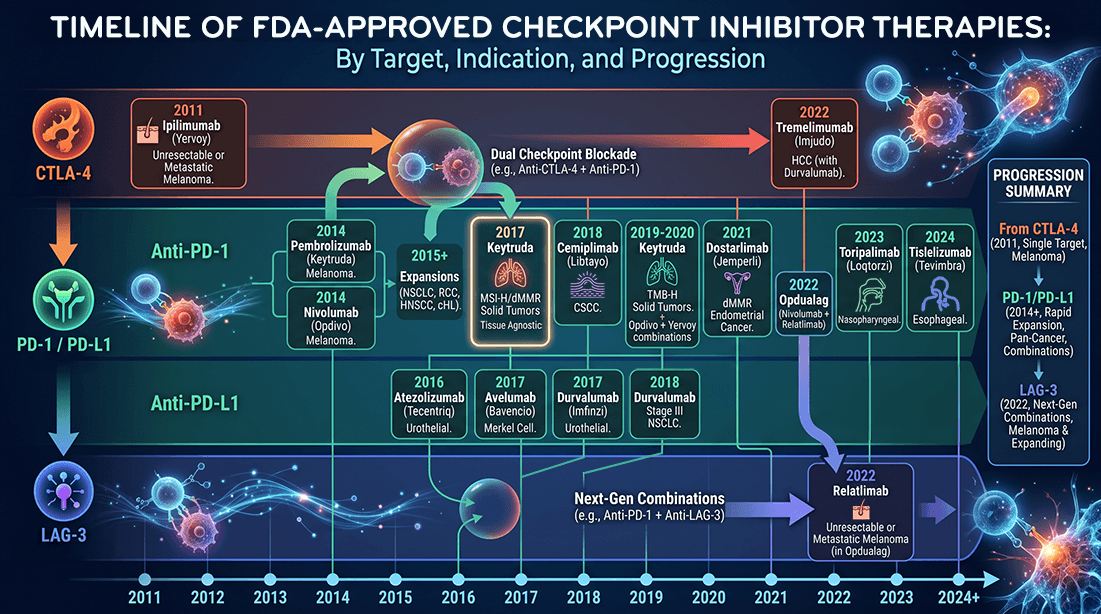
Checkpoint inhibitors are monoclonal antibodies engineered to block inhibitory receptor-ligand interactions, unleashing pre- existing but suppressed antitumor T-cell responses. Anti-PD-1 agents (nivolumab, pembrolizumab, cemiplimab) and anti-PD-L1 agents (atezolizumab, durvalumab, avelumab) are now standard-of-care across melanoma, non-small cell lung cancer, renal cell carcinoma, urothelial carcinoma, and an expanding list of indications. Anti-CTLA-4 (ipilimumab) is frequently used in combination with PD-1 blockade, exploiting non-redundant mechanisms of action (central priming versus peripheral effector-phase suppression) to achieve synergistic, though more toxic, responses.
Biomarker-driven patient selection remains an active challenge. PD-L1 immunohistochemistry, tumor mutational burden, and microsatellite instability status are used with varying predictive reliability, driving continued demand for standardized, sensitive antibody reagents for both diagnostic and research applications. Immune-related adverse events (irAEs)—arising from systemic loss of self-tolerance—remain the principal safety consideration, with management protocols now well established in clinical practice.
The field has moved decisively toward combination and next-generation strategies. LAG-3 blockade achieved a major milestone with relatlimab's FDA approval (2022, combined with nivolumab as Opdualag) for metastatic melanoma, validating LAG-3 as the third clinically actionable checkpoint target. TIGIT inhibitors (e.g., tiragolumab, domvanalimab) have shown mixed but ongoing promise in combination with PD-L1 blockade for lung cancer, with several Phase III trials reporting through 2024–2025 refining patient selection strategies.
Bispecific and multispecific antibodies simultaneously engaging two checkpoint targets (e.g., PD-1 x LAG-3, PD-1 x TIGIT) or pairing checkpoint blockade with T-cell engagement are advancing through clinical pipelines, aiming to improve response rates while limiting combination toxicity relative to co-administered monoclonals. Beyond antibody-based blockade, cytokine engineering, checkpoint-targeted antibody-drug conjugates, and combinations with cellular therapies (CAR-T, TIL therapy) are being explored to overcome resistance mechanisms in checkpoint-refractory tumors. Additionally, VISTA- and B7-H3-directed agents are entering early-phase trials, expanding the addressable target space beyond the T-cell-centric axes that dominated the first therapeutic wave. Novel modalities such as checkpoint-targeting small molecules and peptides are also being investigated as oral alternatives to monoclonal antibody infusion, potentially improving accessibility and dosing flexibility.
For antibody developers, this expanding target landscape underscores sustained demand for highly specific, well-characterized reagents—particularly hybridoma-derived antibodies suited to flow cytometry-based immune monitoring, exhaustion marker co- expression analysis, and functional TME characterization.
Immune checkpoints represent one of the most productive intersections of basic immunology and translational medicine in the past two decades. What began as a mechanism for maintaining peripheral tolerance has become a validated therapeutic framework spanning CTLA-4, PD-1/PD-L1, and now LAG-3, TIGIT, and beyond. As the field moves toward rational combinations, bispecific engagement, and novel targets like VISTA and B7-H3, the demand for precise, well-validated antibody reagents will only intensify—reinforcing the critical role that rigorous antibody development and characterization play in advancing both research and clinical practice in this rapidly evolving space.
Contact us for expert support.