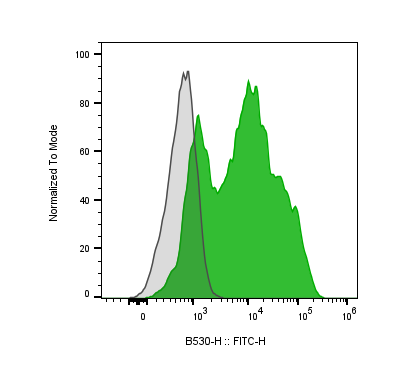
| Cat # | Size | Price | Quantity | |
|---|---|---|---|---|
| 101009 | 25 tests | $120 | ||
| 101010 | 100 tests | $275 |
| Clone | HB-7 |
|---|---|
| Application | Flow Cytometry |
| Reactivity | Human |
| Format | iF488 |
| Target Name | CD38, gp45, Cyclic ADP-ribose hydrolase 1,T10, ADP-ribosyl cyclase |
| Isotype | Mouse IgG1 |
| Antibody Type | Monoclonal |
| Regulatory Status | RUO |
| Formulation | Phosphate-buffered solution, pH 7.2, containing 0.09% sodium azide and 0.2% (w/v) BSA |
| Protein Concentration | Supplied at a lot-specific concentration. |
| Storage&Handling | The antibody solution should be stored undiluted between 2°C and 8°C, and protected from prolonged exposure to light. Do not freeze. |
| Recommended Usage | For flow cytometric staining, it is recommended to use 5 µL of this reagent per 0.5-1.0 million cells in a 100 µL volume. Optimal reagent performance should be determined by titration for each specific application. iF488 has an excitation max at 491 nm and an emission max at 516 nm. |
| Excitation Laser | Blue Laser (488 nm) |
| RRID | AB_3738595 |
| Research Areas | Cancer Marker, T cells, B cells, NK cells, Monocytes, Macrophages, Plasma cells |
| See All Formats | Clone HB-7 |
CD38 is a multifunctional cell surface glycoprotein that plays important roles in immune cell signaling, metabolism, and cell-cell interactions. It is widely expressed on hematopoietic cells, including plasma cells, activated T and B lymphocytes, natural killer (NK) cells, monocytes, and dendritic cells, with expression levels varying depending on cell type and activation state. CD38 is also found on non-hematopoietic tissues, reflecting its broad biological significance.
Structurally, CD38 is a type II transmembrane protein with a short N-terminal cytoplasmic tail, a single transmembrane domain, and a large extracellular C-terminal domain that contains its enzymatic active site. Unlike many CD molecules that function solely as receptors or adhesion molecules, CD38 exhibits ectoenzyme activity. It acts primarily as a NAD⁺ glycohydrolase, catalyzing the conversion of nicotinamide adenine dinucleotide (NAD⁺) into metabolites such as cyclic ADP-ribose (cADPR), ADP-ribose, and nicotinic acid adenine dinucleotide phosphate (NAADP).
Functionally, CD38 regulates intracellular calcium signaling through the generation of cADPR and NAADP, which act as second messengers controlling calcium release from intracellular stores. Through this mechanism, CD38 influences cell activation, proliferation, migration, cytokine secretion, and survival. CD38 also participates in cell-cell interactions by associating with other surface molecules and contributing to immunological synapse formation. CD38 has several functional ligands, most notably CD31 (PECAM-1), which mediates adhesion and signaling interactions between immune cells and endothelial cells. In addition, CD38’s enzymatic substrates, such as NAD⁺, serve as functional ligands that drive its metabolic activity. These interactions integrate immune signaling with cellular metabolism, particularly in inflamed or metabolically stressed environments.
Aberrant CD38 expression and activity are implicated in multiple diseases. CD38 is highly expressed on malignant plasma cells in multiple myeloma and on certain leukemias and lymphomas, making it a valuable diagnostic marker. Elevated CD38 expression is also associated with chronic inflammation, immune exhaustion, and aging, partly due to its role in NAD⁺ depletion. In autoimmune and infectious diseases, altered CD38 expression reflects immune activation and disease progression.
CD38 is a major therapeutic target, particularly in hematologic malignancies. Monoclonal antibodies targeting CD38 have transformed the treatment of multiple myeloma by inducing tumor cell death through antibody-dependent cellular cytotoxicity, complement activation, and immune modulation. Beyond oncology, strategies aimed at modulating CD38 enzymatic activity are being explored to restore NAD⁺ levels and improve immune or metabolic function, highlighting CD38’s growing importance in both immunotherapy and metabolic intervention.
iF488 Mouse IgG1 Isotype Control Antibody
iF488 Anti-Human CD38 Antibody TDS
Anti-Human CD19 Antibody, Clone HIB19
iF560 Anti-Human CD19 Antibody, Clone HIB19
iF647 Anti-Human CD19 Antibody, Clone 019AM2b
Biotin Anti-Human CD19 Antibody, Clone 019AM2b
Human CD38 Protein (C-His-Avi)
Biotin Human CD38 Protein (C-His-Avi)
Anti-Human CD38 Antibody, Clone HIT2
iF647 Anti-Human CD38 Antibody, Clone HIT2
Anti-Human CD38 (Daratumumab Biosimilar), Clone Daratumumab
Have a product or application question? Consult our FAQs or contact us.